
Happy Friday, folks! I have a surprise for you, an artifact of a bygone era when all we needed was an acoustic guitar and a whole mess of words.
We’re throwing it back to the year 2002, when Brother Clyde and I spent a summer in beautiful Yellowstone National Park. In between waiting tables and going on twenty-mile hikes, we sat down with a tape recorder in our dorm room and shouted some songs onto tape. Presented here, for the first time ever, are the liner notes for Two Okies, One Guitar: The Yellowstone Tape, the original Cross-Eyed Yeti recordings!
- “Subterranean Dylan”: As the name suggests, we were aiming for a “Subterranean Homesick Blues” style of song, with way more words per verse than was recommended and way faster guitar than was advisable. I’ve never been particularly happy with the chorus, which will be a recurring theme for this collection.
- “Utopia Joe”: I still love this song. When our old drummer suggested the song needed a bridge, Clyde just played the verse chords, only with a slightly changed strum pattern. It worked.
- “Philosopher King”: When I was just the singer/lyricist, I never really worried about things like “verse length” and “resolution.” This song has since proven to me why such things are important, as each verse is about two lines too long for the chord progression and it always ends up feeling wonky.
- “The Twelve Lines That Didn’t Work”: Typically, I don’t write love songs. I feel silly when I do. This is the first of several that appear on this collection, and…it’s not bad. It’s love gone bad, though. There’s desperation in there, and longing, and a sense that this thing is going to fall apart very, very soon.
- “Weight And Consequence”: Probably the strongest song on here, lyrically-speaking. Like many of our early songs, the chord progression is kinda repetitive, and the verses go on far too long, but it features probably our best performances.
- “The Things That Brought Me Here”: Clyde has never been happy with this one, especially in regards to the way I sing that very first line (I screwed it up so many times, trying to come in before the guitar starts and making sure it’s at the right tempo). It’s another love song, I think. Hard to say, as with so many of the songs I write.
- “Ode To Cock Rock”: Clyde and I are known to be rather…goofy sometimes (see “Country Joe” further down). We also like to jump around to different genres. So, this is our ode to hair metal. It features the infamous “mouth riff,” courtesy of Clyde, a sort of demented guitar solo replacement that only become more elaborate in live performances. Also of note: I cannot sing like a hair metal vocalist. That becomes evident from the very first line of the song.
- “Dancing With A Chick”: The only song I have nothing to do with. This one is all the brainchild of Clyde and our youngest brother, Scott. The true version will feature an instrument called the fish. It will be our finest hour.
- “Clyde’s Blues”: Our finest hour. Or three and a half minutes. It all started with that little riff at the beginning, and me trying my damnedest to sound like a 60-year-old black man born in the Mississippi Delta in 1903. I…do not sound anything like that. But the song is good. We’ve fiddled with it several times over the years, and have enjoyed every single version of the song we’ve ever recorded.
- “I Don’t Need You”: Another highlight. In hindsight, placing these two songs back-to-back was maybe not our best idea, pacing-wise. But hey, it is what it is. We always bust it out whenever we get together, and he even recorded a version of it with his band Family Familiar back in 2022.
- “Never Knew Joy”: Another love song, this one more traditional than a lot of our others. Trying to hit that note at the end of the chorus – “Warmth like the breath of God” – damn near killed me.
- “I Dig Chicks”: Did you know that the chords to “La Bamba” can be used by just anyone? It’s just G, C, and D. You can’t copyright that!
- “The Folk Singer’s Blues”: Sometimes I get contemplative (I know, shocker). And sometimes, those contemplations come out in the form of lyrics. This is another song that’s got way too many words in way too many verses, but Clyde’s guitar riffs are awesome.
- “Desolate Country”: Sometimes, you gotta write songs about home. And this is my first song about home. Oklahoma always strikes me as a strange, almost barren place, Rather…desolate, if you will. It also features Clyde singing! That doesn’t happen very often, and maybe you can spot a couple of the reasons why in this one.
- “Country Joe (Hidden Track)”: If you couldn’t figure out why Clyde shouldn’t sing in the last song, this one should sinch it. A goof on our own song? Why the hell not! “Country Joe” is the dark sibling of “Utopia Joe,” whose heaven lies beside him. Her name is Greta. She likes corn.
- “Desolate Humming (Hidden Track)”: “Desolate Country,” but it’s all hummed instead of sung. Because why not?
 Just outside of Mammoth Hot Springs, at the northern entrance to the park in Gardiner, MT, there’s the Roosevelt Arch. It’s a stone archway bearing an inscription: “For the Benefit and Enjoyment of the People.” Teddy himself went on to add, “Nowhere else in any civilized country is there to be found such a tract of veritable wonderland made accessible to all visitors, where at the same time not only the scenery of the wilderness, but the wild creatures of the Park are scrupulously preserved, as they were the only change being that these same wild creatures have been so carefully protected as to show a literally astonishing tameness. The creation and preservation of such a great national playground in the interests of our people as a whole is a credit to the nation; but above all a credit to Montana, Wyoming and Idaho.”
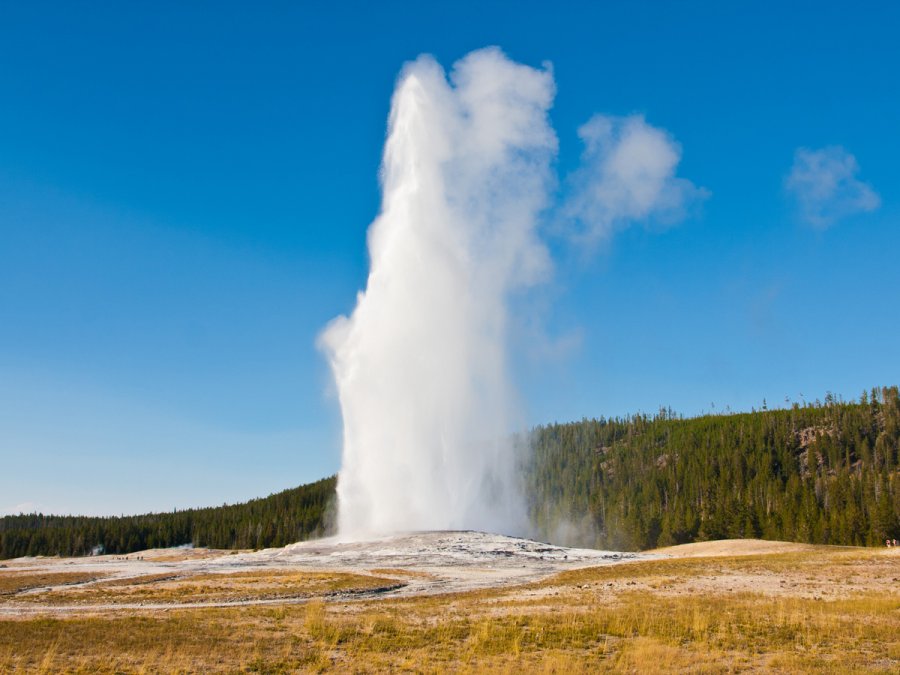 And dammit, he was right. “America’s Best Idea,” as the concept of the National Parks has come to be known, isn’t just a clever advertising slogan. It’s a testament to the enduring idea of setting aside something natural and beautiful and perfect so that others may someday enjoy those things, too. I want my niece and nephews to be able to visit the parks one day. I want them to marvel as Old Faithful shoots steam and boiling hot water a hundred feet in the air. I want them to giggle about the sulfurous stink of the hot springs. I want to see them stand there, mouths hanging open, as a herd of bison amble along the road, completely ignoring the cars. I want them to see wolves and elk and big horn sheep and everything else Yellowstone has to offer, and then I want them to stand on the rim of the Grand Canyon, and hike through the river at Zion, and see the majestic peaks of the Tetons, and maybe – if any still exist – see the Glaciers at Glacier National Park. And none of that will be possible if the federal government has sold off the Grand Canyon so that a state could sell uranium mining rights, or if the forests of Rocky Mountain National Park in Estes Park, Colorado have been logged to the point that only stumps remain.
 Charlie Cottrell