Krober Pass was a few hours west of Halftown, a narrow, rocky pass through the Reeven Mountains. In years past, it had been part of a major trade route to the west, to the Kingdom of Marrowdowns, but the kingdom had fallen to goblin raids decades ago, and the goblins were pushing further and further east with every year. That they’d reached the Krober Pass – so close to the adventurer’s haven of Halftown! – was a sign that things in Marrowdowns were bad.
But it also meant there was plenty of work for folks like Valeria and Garric. The two adventurers were more than a match for anything the goblins could throw at them. Valeria didn’t take any chances, though, performing a ballad designed to improve their endurance and damage resistance before they entered the pass.
Things were quiet as they entered the Krober Pass, the only sound the wind as it whistled through the rocks and thin grass. Valeria had her axe ready, and Garric’s daggers were loose in their sheaths, ready to be deployed at the first sign of trouble. The two had worked together for so many years, there was no need for conversation between them as they moved through the pass. Valeria took point, twirling the axe in her hands and humming an old song under her breath that her mother had taught her years ago.
The only warning they had was the faint sound of rocks skipping down the rock wall, dislodged from above by an unseen foot. Valeria pivoted on her heel, bringing the axe around in a wide arc. The blade caught the first goblin raider under his arms, cleaving him in half and spraying hot blood across the rocks. The short, knocked blade the goblin had held over his head clattered to the ground from nerveless fingers.
Suddenly, the air was alive with goblin war cries and crude weapons waved by cruder creatures. The goblins attacked in waves, falling from above like a deadly rain made of equal parts vile intent, sharp teeth, and rank body odor. Valeria’s axe carved arcs across through the air, chopping goblins down two and three at a time. Garric’s twin daggers flashed, picking out vulnerable points in goblins’ defenses, a throat here, under an arm there, the hamstring and femoral artery of a goblin winding up to take a swing at Valeria. The two adventurers hacked and slashed their way through a small army of goblins for what seemed an eternity, but was really about half an hour. At the end of the carnage, they were still standing, their arms and legs covered in small nicks and cuts, Garric’s left eye swelling shut where he’d caught the edge of a wooden shield in the face. Valeria’s arms were heavy, and she felt drained. Garric was breathing heavily, his barrel chest heaving from the exertion.
“Think that’s all of ’em?” Garric asked, wiping his blades on the edge of his coat and slotting them back into their sheaths.
Valeria shrugged, her shoulders announcing an aching protest at the movement, and stowed her axe on its strap across her back. She pulled out her lute and strummed a few chords, humming a lilting counterharmony to the melody. Garric immediately felt the song’s effects: the ache in his muscles eased, his wounds stopped seeping blood, and he felt generally better than he had a few moments earlier. Valeria put away the lute and took in the terrain of the pass. “No sign of their warren,” she said.
Garric nodded. “Think it’s up in the mountains?”
Valeria nodded. “Of course it is.”
It took them half an hour to pick their way through the massive boulders and shifting gravel of the pass, up the side of an almost sheer cliff face to the cave system the goblins called home. The place was mostly deserted as they entered, though Valeria could feel unseen eyes on her from the moment they slipped into the cool darkness of the cave’s entrance.
Half an hour of exploring the twisting warren of tunnels and caves finally spit them out in a massive, cathedral-esque cavern festooned with candles and bioluminescent fungi. The edges of the cavern were surrounded by massive columns of stala-whatevers – stalactites or stalagmites, Valeria could never keep them sorted in her head – and at the front, like an altar, rose a platform of limestone with a wooden rack taking the place of prominence.
On the rack hung the coat. It had been placed there reverently, as if it were a great, holy relic. Small bundles were heaped at the foot of the rack. On closer inspection, Garric identified them as goblin religious fetishes. “Effigies for the fallen,” he said, stroking his beard. It was the patchiest beard in dwarven history; the mustache, thin and wiry, didn’t meet up with the beard itself, which was more the suggestion of where a beard could be than an actual, fully-realized collection of facial hair. It was an aspirational beard, a beard in potentia, but he was terribly attached to it, as all members of his kind were to their facial hair. Valeria didn’t have the heart to tell him it made him look like wire mesh jutting out at odd angles from his cheeks and jaw.
“I think…they’re worshiping the coat,” Garric said.
Valeria frowned. “Why? It’s an ugly old coat.” She allowed her magical senses to open up to the world around her. Information flooded into her senses. “There’s nothing magical about it. It’s just a plain ol’ coat.”
Garric shrugged. “Damned if I know. The old bastard did kill a lot of goblins in his day.” Valeria nodded. Everyone in Halftown knew, if there were no other jobs available, you could always kill goblins. The man in the coat had been well-known for taking that job even when other, more worthwhile endeavors were available. An idea, a terrible notion, formed in her mind. She didn’t care for it, though it made a certain amount of sick sense.
“They started thinking of him as a god of death, didn’t they?” she said. Though the tone was one of question, it was really more an uncertain-at-worst statement. “They think they killed a god, and they took a holy relic as a sign.”
Garric shrugged again. “Stranger things have happened.” He glanced around the cavern. Like Valeria, he couldn’t shake the sense that they were being watched from every dark corner. “So, what do we do? We takin’ the coat back?”
Valeria shook her head. “No. There’s no point. It’s just an old damn coat.” She stretched, arching her back, and turned back to the entrance they’d come in through. “Let’s get back to the Giant’s Barrel. I need a drink.”
Garric grinned. “That’s a damn fine idea!” he said in agreement. “We’ll hoist a tankard to…um…” Garric scratched his chin. “Say, what the hell was the guy’s name, again?”
Valeria shrugged. “I dunno. Dave? Saunders? Caulder? Who knows? Better, who cares? I need a damn drink.”
 en better. And that’s down to the fine folks who designed it all.
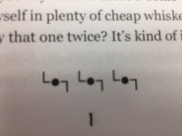 book isn’t composed entirely of commas. She made some great choices, too: the font for each section heading page is awesome, and the little symbol she used in place of my * * * between subsections? It’s freakin’ cool. I mean, look at it!
