From the Ashes

As I type this, the book is going through Kindle Direct Publishing’s setup process.  I’ve got everything uploaded, and the Royal James version of the book has been taken down off the web.  Within a day or two, the book will be available on Amazon again, this time directly from me.

It’s a little strange, going back to doing it all myself.  No more middle man nonsense.  I get to control the price and see the results and the totals and not have to sit here, wondering about everything because I don’t have any access to the data.

I’m still not sure if it’ll be better or worse.  It’ll be different.  Everything is back on my shoulders now.  I’m not just the guy writing the book anymore; I’m also responsible for the marketing and the formatting and everything in between.  That’s probably for the best.

It’ll take another day or two for me to set up the paperback version again.  I need to make sure everything is kosher and they don’t try to take it down because it’s exactly like a book that was just taken down off the site.  Good times.

Just Like Starting Over

I’ve been busy in the few days since Royal James disappeared.  I’m just waiting for them to take The Invisible Crown down off Amazon and other sites so I can reupload it myself.  In a bit of a holding pattern on that because, as I just said, I’m waiting on someone else to do a thing.

But! in the meantime, I have not been resting on my laurels.  No, I have been very busy getting things up and running for the next book.  The year with Royal James taught me several things, among them (1) work with people you trust and (2) you get what you pay for.  The last time I was doing the self-publishing thing, I tried to do everything by myself: editing, formatting, cover design and layout, marketing, etc.  And, when I could snatch a free moment from all that, I’d even manage to do some writing now and then.

This time around, I’m taking a different approach.  A book is not all that dissimilar from a child, and both take a village to bring up right.  To that end, I’ve contacted various individuals known to me to help out with editing and cover design.  I haven’t decided whether or not to bring in outside help on formatting; I have the formatted files for the first book, and I think I could just use those as a guide (and create some internal style consistency, which would be nice).  That’s all still a few months down the road, though.  I anticipate being able to get the second book out in September or so, and the third book probably by summer next year.  I want to accelerate the timeline Royal James had been planning (a book a year) to something that puts more books in people’s hands faster (I’m leaning towards a release every nine months or so until I’ve put out all the books I’ve already got written, then we’ll see how long it takes in between new ones after that).

Additionally, I’ve decided to pursue something of a mad idea I came up with back when TIC came out: an audio book.  I know, it seems silly to do an audio book of a novel only a few dozen people have read, but (1) I’m hoping to get more readers in the coming months and (2) it’s my book, shut up.  All that said, I’ve got several friends who’ve stepped up and offered to contribute their vocal talents to the project, and I started working out what characters are in each scene yesterday so I can have an idea how many different people we’ll actually need.

I’m also – and this might be the most relevant thing of all – writing again!  It’s been a few months since I felt like putting words to the page, for whatever reason.  But lately, I’ve started up a couple of new stories, at least one of which will probably turn into a novel (or even a series of novels!).  It’s a good feeling, to have words showing up when I sit down to write.

Anyway, stay tuned!  As soon as I’ve got complete control of the book, I’ll do a giveaway with some fabulous* prizes!


* – Quality of prizes may be slightly exaggerated.

Independent

So apparently Royal James Publishing has closed its doors.

This was…surprising news to find in my inbox this morning.  Their website is gone, their twitter is gone, their entire online presence has been wiped overnight.

My book is still available from Amazon at the moment.  I’m not sure how long that will last.

Now, before anyone panics and thinks that my book is gonna disappear from the shelves forever, know that I have the rights and all the appropriate files and I’ll keep the book up on Amazon and Smashwords and all that.  I’ll also be self-publishing the next book, The Hidden Throne, sometime later this year, and all subsequent books and stories in the series.

Here’s where it gets kind of interesting for me.  While I enjoyed my relationship with Royal James and appreciated their support, self-publishing is actually going to be much better for me.  I won’t pretend Royal James didn’t frustrate me sometimes; the publisher was sometimes hard to get in contact with and not particularly transparent with important information about sales and the editing/pre-publishing process.  I am gonna have to pay for editing and book covers and formatting and stuff like that myself now, which is a bummer.  But I’ve got a helluva lot more freedom.  I can sell the book for whatever price I want.  I can do giveaways and sales and things of that nature.  I don’t have to get someone else’s approval for anything.  and I can schedule book releases whenever I want to (instead of having to wait for what’s convenient for the publisher’s publishing schedule).

So, looking at the ol’ pros and cons list, it’s coming up way more pro than con, I think.  My year with Royal James was enlightening, and I’ve come out of it much more knowledgeable about the publishing process than I was before.

Stay tuned for more information about upcoming releases and side projects!  Oh, I have so many side projects I wanna do, you don’t even know.

Philosophy Jokes and New Writing

After spending all of last week down with the sickness (i.e., strep), I’m feeling much better as the final week of the third quarter begins.  Spring Break is close, the weather is turning spring-like, and all the students are complaining about things like having to take exams and come to class and do work and why is there such a thing as school anyway?  Admittedly, students complain regardless of the time of year, so I’m not sure that’s an indicator of the arrival of spring.

Spring has also brought with it a renewed writing energy.  I’ve been in a bit of a prose slump lately, focusing more on writing songs (though even that has slowed to a trickle in the past month or so), so when I woke up with an idea for a Hazzard story today, I decided it was time to run with it.

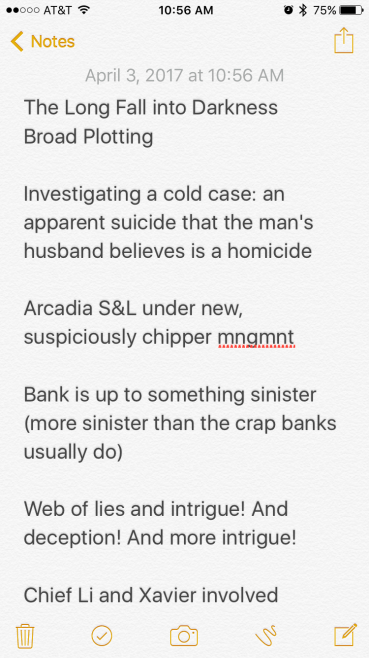
I don’t know where in the Hazzard timeline this story takes place quite yet (after Book 2, at the very least).  It may end up bumping Books 3, 4, 5, etc., further down the road.  It might just be a short story or a novella, I don’t know yet.  I have been doing some broad-strokes plotting, which is generally all the more specific my plotting gets.  I thought I’d share a bit of this roughest of outlines with you, just for fun:

2017-04-03 10.56.28.png

As you can see, it’s far from a complete, detailed outline, but I only started working on it this morning.  More will come with time.

I’m also pretty pleased with the working title, The Long Fall into Darkness.  Is that subject to change?  You betcha!  As a working title, though, it’s got some legs.

Brain Droppings

I don’t really have any specific topic to rant about today, so I’ll just give you a rundown of how my week has gone and hope that it’s entertaining enough for you.  If it’s not, tough; I’ve been sick most of the week, so my ability to care has been greatly diminished.

Monday was my birthday.  I’ve inched into the “late 30s” demographic, and realized I’m closer to AARP than I am to high school.  Or college, even.  I did get to see my brother, who stopped by on his way to DC for some meetings (yeah, he does meetings with members of Congress in DC, the poor bastard).  My wife bought me many books for my birthday (including Neil Gaiman’s new Norse Mythology, which I’m going to enjoy the heck out of), and my sister-in-law got me the Hamilton Soundtrack on vinyl, because she is the awesomest.

hqdefault

Me, on Tuesday.

As I mentioned earlier, I’ve been pretty ill this week.  Sore throat, aching body, head that felt like it might fall off if I moved it too quickly.  On Tuesday, I was able to lay in bed all morning and then on the couch all afternoon, but didn’t feel up to anything else (I think I managed to drink a ginger ale or two that afternoon and I ate some Saltines, but that was it).  Wednesday was somewhat better.  My body didn’t feel like it was betraying me every time I moved and my head felt clearer, though my throat was still sore.  I was able to do things like go to the Apple Store to find out what was wrong with my laptop (answer: battery was swelling, which was not something I was aware batteries did), then run around all creation getting what I needed to replace said battery.  It’s done, thankfully.

Today…well, I’ve come in to work this morning, but I’m wondering if it was the right choice.  My throat is still very sore, and I spent five minutes this morning dry heaving for no apparent reason.  So that was good times.

Anyway, my dad’s supposed to be in the area this weekend while he and his wife are in DC for a thing at the Museum of the American Indian.  I looking forward to getting to see them.  Assuming I can stop dry heaving, that is.

Steen Jones’ The Door Keeper

When I’m not busy writing, or drawing, or playing music, I’m busy reading.  Or sleeping.  There’s only so many hours in a day, after all, and I love to take naps.

But the book I’m here to tell you about!  I read fellow Royal James Publishing author Steen Jones’s contemporary fantasy book The Door Keeper last week, and I’m gonna tell you all about it.

First and foremost, you should read it.  The Door Keeper is a pleasant, heartwarming novel, filled with believable characters, an intriguing mystery, and clever fantasy elements.  It never feels trite or cliche, even when dealing with well-worn tropes of the genre (the main character has a mysterious past she knows nothing about and a great destiny!  Here’s a brooding man who starts off somewhat combative but comes around and becomes a boon companion and love interest!).  It’s a testament to Ms. Jones’ abilities that the character don’t feel flat or their arcs unearned.  She excels at the little character moments that make their feel real: the way the protagonist’s daughter, Gabby, goes on and on about filming Youtube videos with her best friend, or the way Eden, the protagonist herself, decides to hide information from her daughter to protect her.  It feels natural, as do almost all the character interactions and moments.

I’m not going to go too deep into the plot, as revealing too much does give away some of the twisty surprises Steen Jones has cooked up for her reader.  Folks in this book have ulterior motives sometimes, and not everyone is on the up and up like they pretend to be.

What I enjoyed most about The Door Keeper was the way Ms. Jones played with developing exciting and unique worlds for her characters to visit.  See, there are all these doors scattered across the earth that act as portals to other worlds, if you happen to have a key to the doors.  We see three other worlds in this novel, though the next two books (it’s a planned trilogy) promise visits to other worlds, I hope, because Steen is pretty creative when it comes to these exotic locales.

All of this isn’t to say I didn’t have a couple of issues with the novel.  Ms. Jones has a habit of creating a potential obstacle for Eden, then immediately removing that obstacle without any effort on Eden’s part.  The not-too-conflicting-conflict makes for some resolutions that are a bit too pat, a little unearned.  Eden has all of this internal struggle that we get to see because she’s our narrator, but we don’t really have any external conflict because as soon as she thinks about something being a problem, someone ambles into her path and provides the exact solution she was looking for.  There’s also a few bits where the prose isn’t as polished as it could be, though I’m certainly willing to forgive a typo here and there (lord knows I’ve made plenty of my own).

All in all, The Door Keeper is a solid start to a series.  Steen Jones creates a wonderful world full of sparkling details and then goes on to create several more worlds with even more details.  Her world building is excellent, her character moments are spot on, and the book resolves its central plot in a fairly satisfying way while also setting up the next book in the series.  I’m looking forward to whatever is in store for Eden and company next!

Flash Fiction: Valeria’s Song

The Giant’s Barrel, a rough-and-tumble pub in the worst part of Halftown, was exactly what you’d expect it to be.  The proprietor, Grim Harstaff, saw to it that was the case: he personally sloshed beer onto the half-rotted straw strewn across the floor.  He’d put several of the nicks and notches on the bartop himself with an old dagger from some ancient war campaign he’d fought in a lifetime ago.  The place was kept dimly-lit, smelled of stale sweat and beer, and had air the general consistency of a thin gruel.  Certain qualities were expected, he said, and he wanted to provide the right ambiance to his clientele.

Valeria liked the Giant’s Barrel.  The beer was cheap, most of the men drinking there didn’t try to ogle her, and Grim would occasionally let her play her lute on the makeshift stage Grim and Garric would erect with a few planks over a couple of barrels at one end of the bar’s great room.

Not that Valeria ever understood why anyone wanted to ogle her.  She was a barbarian from the great northern tribes, where they bred their men and women for heartiness, not loveliness.  Her chest was better described as pecs rather than breasts, and she had broader shoulders than almost all of the pub’s regulars.  And, as the Giant’s Barrel was the watering hole for mercenaries and soldiers of fortune, adventurers and treasure hunters, this was saying something significant.

She kept her hair cropped short; she usually cut it herself with her dagger, the same blade that she cut her meat and stabbed her foes with.  Valeria was not picky about her appearance.  She had no interest in attracting a mate or even a brief romantic partner.  Valeria would rather learn a new tune than bed someone.  Yes, she’d had her dalliances as a young woman; she’d taken men and women to bed, searching for that spark that so many others described when engaging in bedroom shenanigans.  But she’d never felt it, and had accepted that it just wasn’t for her and moved on to more important things.

Most important was her music.  Her instrument was meant for delicate, gently-plucked melodies, but she’d always hammered on the strings like they were slabs of metal hot from the smith’s forge.  Valeria’s maestro when she was a young woman – a small, bald old man with nearly-useless eyes and the sharpest hearing imaginable – lamented her wasted talent.  “You could play any song you set your mind to,” he said, “but you always choose these old drinking songs and tavern sing-a-longs.”  And then he’d mutter to himself for the rest of her lesson.

Valeria was also unique in her ability to turn her tunes into magic spells.  The bardic spellcasting skill was virtually unheard of among her tribe; not that there were many bards in her tribe to begin with.  She’d been destined for training as a berserker.  She was certainly built for it, and no one excelled in shield biting like Valeria.  But she loved music more, and snuck away from her martial tutors and made for the city of Melorica, where she found the best musicians she could and started learning everything possible about playing.  Within a few years, she had a reputation as a daring interpreter of existing compositions and a lyrical, innovative composer in her own right.  The fact that she liked to write drinking songs for the common man was a source of some embarrassment among the musical intelligencia, but Valeria did not care even a little.  She loved what she played, and she found a way to turn her music into supportive spells for her allies in battle.

And Valeria was finding herself drawn to battle.  Yes, she’d abandoned her studies with the tribal war master, Carrouk, years earlier, but she still had the blood of the Hoursmooth tribe flowing in her veins, and she still felt the need for glorious battle.

So she’d taken up with the dwarf, Garric, and started adventuring.  And it fulfilled a need she’d forgotten she had, sated a desire that she’d thought she’d buried years ago.  That she got to combine her desire for battle and her love of music to become the world’s only barbarian bard was just icing on the proverbial cake.

Occasionally, though, Valeria felt the need to just play music for the sake of playing music.  On those occasions, she would head to the Giant’s Barrel, have Garric and Grim assemble the makeshift stage, and sit on the stage for hours at a time strumming and plucking the strings of her lute.  She played familiar folk tunes, drinking songs passed down for generations that everyone knew the words to, and original compositions of her own.  The crowds were always appreciative, clapping and hooting and singing drunkenly along.

There was one song, though, that Valeria never played at the pub.  One song that she kept to herself, only played when she was alone.  It was a sad song, a song full of longing and nostalgia and sentiment.  Anyone who knew Valeria would have been surprised she had an ounce of sentimentality in her soul; barbarians were not well-known for their pathos.  It was a song about home, about growing apart from everything you knew, about loneliness and the desire for amiable companionship.  Not about love, not exactly, but about something akin to it, like friendship only deeper.  Someone to share things with.  Garric came close, Valeria would admit, but he wasn’t quite it.

So the song was for herself, and no one else.  Maybe someday, someone else would get to hear it.  Maybe she’d even share it with Garric, if the time was right.  But for now, it was hers alone, and she would sit and play it for herself on quiet nights when no one was around.
 

Flash Fiction: The Coat, Part 2

Part 1 can be found here!

Krober Pass was a few hours west of Halftown, a narrow, rocky pass through the Reeven Mountains.  In years past, it had been part of a major trade route to the west, to the Kingdom of Marrowdowns, but the kingdom had fallen to goblin raids decades ago, and the goblins were pushing further and further east with every year.  That they’d reached the Krober Pass – so close to the adventurer’s haven of Halftown! – was a sign that things in Marrowdowns were bad.

But it also meant there was plenty of work for folks like Valeria and Garric.  The two adventurers were more than a match for anything the goblins could throw at them.  Valeria didn’t take any chances, though, performing a ballad designed to improve their endurance and damage resistance before they entered the pass.

Things were quiet as they entered the Krober Pass, the only sound the wind as it whistled through the rocks and thin grass.  Valeria had her axe ready, and Garric’s daggers were loose in their sheaths, ready to be deployed at the first sign of trouble.  The two had worked together for so many years, there was no need for conversation between them as they moved through the pass.  Valeria took point, twirling the axe in her hands and humming an old song under her breath that her mother had taught her years ago.

The only warning they had was the faint sound of rocks skipping down the rock wall, dislodged from above by an unseen foot.  Valeria pivoted on her heel, bringing the axe around in a wide arc.  The blade caught the first goblin raider under his arms, cleaving him in half and spraying hot blood across the rocks.  The short, knocked blade the goblin had held over his head clattered to the ground from nerveless fingers.

Suddenly, the air was alive with goblin war cries and crude weapons waved by cruder creatures.  The goblins attacked in waves, falling from above like a deadly rain made of equal parts vile intent, sharp teeth, and rank body odor.  Valeria’s axe carved arcs across through the air, chopping goblins down two and three at a time.  Garric’s twin daggers flashed, picking out vulnerable points in goblins’ defenses, a throat here, under an arm there, the hamstring and femoral artery of a goblin winding up to take a swing at Valeria.  The two adventurers hacked and slashed their way through a small army of goblins for what seemed an eternity, but was really about half an hour.  At the end of the carnage, they were still standing, their arms and legs covered in small nicks and cuts, Garric’s left eye swelling shut where he’d caught the edge of a wooden shield in the face.  Valeria’s arms were heavy, and she felt drained.  Garric was breathing heavily, his barrel chest heaving from the exertion.

“Think that’s all of ’em?” Garric asked, wiping his blades on the edge of his coat and slotting them back into their sheaths.

Valeria shrugged, her shoulders announcing an aching protest at the movement, and stowed her axe on its strap across her back.  She pulled out her lute and strummed a few chords, humming a lilting counterharmony to the melody.  Garric immediately felt the song’s effects: the ache in his muscles eased, his wounds stopped seeping blood, and he felt generally better than he had a few moments earlier.  Valeria put away the lute and took in the terrain of the pass.  “No sign of their warren,” she said.

Garric nodded.  “Think it’s up in the mountains?”

Valeria nodded.  “Of course it is.”

It took them half an hour to pick their way through the massive boulders and shifting gravel of the pass, up the side of an almost sheer cliff face to the cave system the goblins called home.  The place was mostly deserted as they entered, though Valeria could feel unseen eyes on her from the moment they slipped into the cool darkness of the cave’s entrance.

Half an hour of exploring the twisting warren of tunnels and caves finally spit them out in a massive, cathedral-esque cavern festooned with candles and bioluminescent fungi.  The edges of the cavern were surrounded by massive columns of stala-whatevers – stalactites or stalagmites, Valeria could never keep them sorted in her head – and at the front, like an altar, rose a platform of limestone with a wooden rack taking the place of prominence.

On the rack hung the coat.  It had been placed there reverently, as if it were a great, holy relic.  Small bundles were heaped at the foot of the rack.  On closer inspection, Garric identified them as goblin religious fetishes.  “Effigies for the fallen,” he said, stroking his beard.  It was the patchiest beard in dwarven history; the mustache, thin and wiry, didn’t meet up with the beard itself, which was more the suggestion of where a beard could be than an actual, fully-realized collection of facial hair.  It was an aspirational beard, a beard in potentia, but he was terribly attached to it, as all members of his kind were to their facial hair.  Valeria didn’t have the heart to tell him it made him look like wire mesh jutting out at odd angles from his cheeks and jaw.

“I think…they’re worshiping the coat,” Garric said.

Valeria frowned.  “Why?  It’s an ugly old coat.”  She allowed her magical senses to open up to the world around her.  Information flooded into her senses.  “There’s nothing magical about it.  It’s just a plain ol’ coat.”

Garric shrugged.  “Damned if I know.  The old bastard did kill a lot of goblins in his day.”  Valeria nodded.  Everyone in Halftown knew, if there were no other jobs available, you could always kill goblins.  The man in the coat had been well-known for taking that job even when other, more worthwhile endeavors were available.  An idea, a terrible notion, formed in her mind.  She didn’t care for it, though it made a certain amount of sick sense.

“They started thinking of him as a god of death, didn’t they?” she said.  Though the tone was one of question, it was really more an uncertain-at-worst statement.  “They think they killed a god, and they took a holy relic as a sign.”

Garric shrugged again.  “Stranger things have happened.”  He glanced around the cavern.  Like Valeria, he couldn’t shake the sense that they were being watched from every dark corner.  “So, what do we do?  We takin’ the coat back?”

Valeria shook her head.  “No.  There’s no point.  It’s just an old damn coat.”  She stretched, arching her back, and turned back to the entrance they’d come in through.  “Let’s get back to the Giant’s Barrel.  I need a drink.”

Garric grinned.  “That’s a damn fine idea!” he said in agreement.  “We’ll hoist a tankard to…um…”  Garric scratched his chin.  “Say, what the hell was the guy’s name, again?”

Valeria shrugged.  “I dunno.  Dave?  Saunders?  Caulder?  Who knows?  Better, who cares?  I need a damn drink.”

Another Old Guitar

I have many guitars.  Too many, depending on who you ask.  But each one serves a very real, important purpose!  Of course I have the Fender Mustang my wife’s uncle gave to me.  I also have a bass guitar and a G & L Bluesboy Tribute (think semi-hollowbody Telecaster), a couple of Martin acoustics, and the beater.

The beater was a gift from a former coworker.  My first year of teaching, I bought a crappy, terrible-sounding Epiphone acoustic, the cheapest damn guitar I ever laid hands on.  It played awful, too, and I got rid of it after that first year of teaching.

I was able to get rid of it, in large part, because this coworker came in one morning carrying a guitar case that had seen much better days, probably sometime back before the BC/AD switch over.  There was a spot where a hole had basically been punched through the case, the handle was gone and replaced with a shoelace, and the whole thing basically looked like it had sat in someone’s attic for the better part of a decade.

“It sat in my mom’s attic for about a decade,” the coworker said.  “Do you want it?”

I shrugged.  “Sure, why not?” I replied.  “You can never have too many guitars.”  And hey, this was a type of guitar I didn’t have: a 3/4 classical guitar (a guitar three-fourths the size of a usual acoustic.  Classical guitars also differ from a standard acoustic guitar in that it uses a combination of nylon and phosphorus bronze strings instead of just six phosphorus bronze strings.  It also has a slightly-wider neck to accommodate the fact that classical guitars are meant to be fingerpicked, though that’s never stopped me from strumming like holy hell with a pick).

The guitar itself was in rough shape, cosmetically, but still played perfectly after I replaced the ancient strings.

The guitar became my school instrument, the one that I kept in my classroom and picked up to strum when the mood took me.  I’ve written dozens of songs with that guitar over the years, and it still sounds lovely.  But the case, which was falling apart and pretty worthless when I got the guitar twelve years ago, has recently started deteriorating even further.  The shoelace handle was actually breaking, one of the hinges detached from the body of the case, and the thing was just really falling apart completely.  So, over the weekend, I went out and purchased a new gig bag for it.  The fact that the gig bag is worth as much as the guitar itself was a bit odd, but what can you do?  The guitar is still good.  It’ll remain playable for years to come, assuming nothing horrible happens to it.  And with the new gig bag, nothing horrible should happen to it.

So, farewell, crappy classical guitar case.  You served me well, but the time has come for you to retire.  To the dumpster.

Flash Fiction: The Coat, Part 1

It was black leather, faded with years of neglect and abuse.  It hung heavy across his broad back and shoulders, the hem of the coat hanging down to mid-thigh.  It slapped against his legs as he took each step, as though the edge of it was weighted somehow.  The coat was festooned with pockets, though no one knew quite how many or what their contents might be.

It was worn in a patch around back, where the leather had scrapped against booths and benches and the rough brickwork of city alleyways for years and years.  It was a hard-worn coat, full of secrets and dried blood.  He’d been stabbed three times while wearing the coat; shot with arrows at least twice as many times as that.  He survived, and so did the coat.  Some new stitching, and each were patched up again.

Folks around the city recognized the coat and its wearer.  They became something of an institution, a familiar, mobile landmark in the city that wandered the streets in search of work and adventure.

Some coveted the coat, not because it was a particularly appealing piece of sartorial splendor, but because it represented something primal and daring and great: the coat was as much an adventurer as its wearer.  The coat had survived just as many narrow escapes and famous last stands as the man who wore it.  The coat was a piece of history, one that could be passed on like a torch or a crown or a family heirloom.  The man had no children – none he knew of or was in contact with, anyway – so the coat would just be buried with him when he died, assuming he was buried and not just left on some desolate battlefield or deep in some dank dungeon to rot.  It would be a damn shame for that coat to not go on, these folks reasoned, and so they tried to steal it and discovered the man who wore the coat was not an individual to be trifled with.

No one could say for certain how old the man was, or when he’d first appeared in the city, but everyone agreed they’d never seen him without the coat.  It was as much a part of him as his arms or his eyes, as important a tool in his arsenal as any sword or dagger.  He wore it during the defense of Halftown, and the brawl in the Giant’s Barrel that followed the glorious victory in that battle.  He wore it when he explored the fabled Catacombs of Meril Catharak, where he defeated the Lich Lord of the same name.  He wore it when he wooed the beautiful princess of Dorivo Tower, though he declined to ravish the princess in favor of ravishing her brother, the tower’s defender.

The man wore the coat everywhere, regardless of weather or circumstances.  It was like a uniform, a second skin, an indispensable garment by any measure.

So it came as some shock to everyone when he died without it on.

It came in the fourth month of the Year of the Notional Serpent, deep in to the sweltering summer season in Halftown, the city of heroes and adventure.  The man came stumbling into town one evening near dusk, blood matting his hair and the coat nowhere to be seen.  He collapsed in front of the Giant’s Barrel, bleeding from more wounds than any living person could reasonably expect to survive, and the life ebbed out of him as adventurers stepped over and around his prone form to reach the bar inside the Giant’s Barrel.

Only two individuals stopped to check on the man: Valeria, a tall woman from the great northern barbarian tribes, and her stout dwarven companion, Garric.

“He’s dead,” Garric said, straightening up from a stoop next to the man, though it hardly seemed worth the effort given how minor the effect of standing was on his overall stature.  Garric was, to put things bluntly, short.

Valeria nodded.  She’d assumed as much.

“No sign of the coat,” Garric muttered, eyeing the dusty street.  No one else was around; even at dusk, the city was so stiflingly hot that most people were quietly suffering indoors.

“That damn coat is more trouble than it’s worth,” Valeria said.  She didn’t put much stock in the legends and stories surrounding the coat.  Many thought it was enchanted, spelled against blades and blows.  Valeria was convinced it was just an old, ugly coat, but she also knew you couldn’t discount an item’s magicalness when so many people believed in it.  Belief had a power that was hard to beat.

“What job was he on?” Valeria asked despite herself.  She didn’t want to try to find the coat, but she could see the shape of the narrative forming around her.  Someone was going to go out and find the damn thing; it might as well be someone competent.  It might as well be her and Garric.  The man in the coat had always been known for taking on challenging jobs, and it was better that professionals take up the task than some amateur with delusions of grandeur.

“Clearing out the goblins in the Krober Pass,” Garric said immediately.  His memory for little details – like who had taken what job on the Adventurer’s Community Board – was sharper than most.

Valeria hefted her axe over one shoulder and her lute over the other.  There weren’t too many barbarian bards out there, and she was easily the best of them.  Garric rested his hands on his daggers, arching his back until the vertebrae popped one after the other.  “Right, then,” the dwarf said, a grin splitting his bearded face, “let’s get to it.”

Continue on to Part 2!