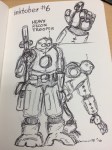
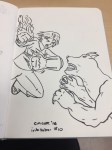
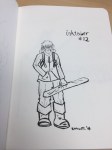
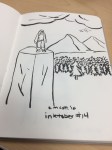
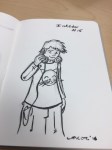
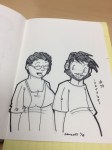
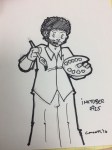
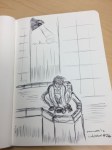
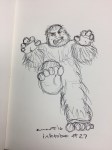
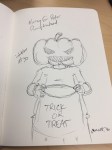
I love to draw (as anyone who follows the webcomic knows full-well), and I decided it’d be fun to do the #inktober thing for October: a drawing a day, in ink. Some of them were pencil drawings that I then inked with a variety of pens (some were brush pens, some were Prismacolor markers, and several were done with an ultra-fine Sharpie and a regular Sharpie for a bold outline). Others were done, start to finish, with regular ol’ ballpoint pen. Here’s all 31 inky drawings for your enjoyment!
Halloween Playlist
Are you like me, and find yourself wanting to enjoy Halloween but struggling because of a dearth of decent songs associated with the holiday? I mean, in terms of inspiring music, it’s not Christmas, that’s for sure. I just find that I can’t stand listening to the Monster Mash and the Addams Family theme and the Munsters theme again and again on repeat this year. I need some actual, non-novelty music.
And we’re in luck! There are actually plenty of real, pretty awesome songs that have a stealth-Halloween theme to them. Here’s a selection of some of my favorites.
1. The Eagles, “Witchy Woman”: Sure, it’s easy to rag on the Eagles as being the dad-est of Dad Rock, but they did some fun songs. This one carries the witch metaphor throughout pretty strongly, and fits right in with our “real song but Halloween-y” theme.
2. Creedence Clearwater Revival, “I Put a Spell on You”: Yeah, I know, the Screamin’ Jay Hawkins version is probably better, and certainly more Halloween-y, but I can’t pass up the opportunity to include a CCR song on a playlist.
3. The Beatles, “Devil in Her Heart”: Not even a little bit of the right tone, barely even mentions anything Halloween-related (the titular devil in her heart, which is more metaphorical than actual), but it’s the Beatles, and it’s my playlist, so nyah.
4. Warren Zevon, “Werewolves of London”: There was a 0% chance I wasn’t going to include this. An obvious but classic choice.
5. Tom Petty, “Zombie Zoo”: “Sometimes you’re so impulsive/You shaved off all your hair/You look like Boris Karloff/But you don’t even care” is probably the best line in any song ever, and I will fight you if you say otherwise.
6. Josh Ritter, “The Curse”: A love song about a mummy told as sincerely as this is proof this world is sometimes better than we deserve.
7. Nick Cave & the Bad Seeds, “Red Right Hand”: Honestly, you could just put a Nick Cave & the Bad Seeds album on for Halloween it’d be fine. If I have to go with one song, though, this is the one. The Pete Yorn version from the first Hellboy movie isn’t half-bad, either.
8. Jeremy Messersmith, “Ghost”: A haunting beautiful (get it?) song about disappearing out of someone’s life.
9. The Flaming Lips, “Yoshimi Battles the Pink Robots, Part 1”: War of the Worlds, if it was fought between a Japanese pop singer who knows karate and giant pink robots that want to eat people.
10. The White Stripes, “Walking with a Ghost”: I don’t have a whole lot to say about this one. I just wanted another song about ghosts on here.
Happy Halloween, everyone!
My Story
While I attempt to dig myself out of my depressive funk, enjoy this thing I wrote years ago that I re-read the other day and didn’t hate.
—
When I write my story, there will be no hero. There will be no happy ending.
There will be an infinite sadness, a streak of pain painted across the night sky, an arc of red against a field of black.
There will be blood, and a wailing, and a gnashing of teeth.
And ponies. There will probably be ponies.
* * *
My main character will not be a white male. No, my protagonist won’t even be human, or sentient, or recognizable as a character. It’ll be a bacterium, or a fugus, perhaps a particularly plucky protozoa.
There won’t be a determined, independent woman in the story, either. No humans at all, except maybe as the setting. Or the antagonist. We’re pretty antagonistic towards every other living thing in existence, it seems, so we’d make pretty damn convincing antagonists.
* * *
I don’t really think I’ll have a theme, or follow much in the way of writing conventions. Everyone’s done pretty much everything you can with stories that make sense, that follow narrative structure. Hell, everything’s been done with stories that don’t follow narrative structure. I’ve read Joyce and Bely, I know all about that whole stream of consciousness nonsense.
My story will be told through pheromones and suggestive twitches of flagella.
* * *
It won’t be a long story. There’s no need to go on for thousands and thousands of pages, hundreds of thousands of words stacking up like bricks in a wall or CDs on a club kid’s nightstand. There may only be a single word to my magnum opus. It’ll be a word that rolls over the tongue, one that lolls about in the mouth, coating everything in a thin film. Something like “lugubrious,” or “gibbous,” or possibly “sumptuous.”
Or maybe it will just be a description of some hardcore bestiality for a thousand pages. I’m not set on anything just yet.
* * *
Ultimately, no one will read my story. It will exist only in my head, if even there, and only for a short while if at all. I’m not entirely certain the world is ready for my work of speculative flash fiction featuring an unknowable protagonist and us as the antagonist. It’s a bit of a stretch, really.
Also, I haven’t found a publisher, and I’m sure as hell not gonna self-publish this mess.
No Depression
If I’m honest with myself – and, to be honest, I’m often not – my depression has been a problem lately. It’s left me feeling listless and worthless, which isn’t uncommon for me.
I’ve been like this…well, pretty much always, I guess. These bouts of lowness, of feeling like I’d be better off not existing, like maybe no one would really notice or mind that much if I wasn’t around. It’s a terrible way to feel.
The disjointedness. Feeling like I’m jumping from rock to rock, idea to idea, with no coherent connection between them. Hopping across stones over a rushing river, or maybe it’s lava. Not caring enough to look down to find out. What does it matter, if it’s water or lava? Falling in would kill me just as dead either way.
Or the emptiness. The sense that you’ve somehow become hollow inside, waiting to be filled up by something, anything, but nothing is forthcoming. It’s disheartening.
With the emptiness comes the loneliness, the isolation, the sense of being cut off from everyone. Like there’s no one I can talk to about it, no one who would understand.
I came to work this morning, more out of habit than anything. I didn’t want to come in. I didn’t feel like I could contribute anything worthwhile. I wanted to call in sick, to be honest. Call in depressed. Is that a legitimate reason to be out? It should be, but it probably wouldn’t look that way from the outside. Because the truth is, I just don’t feel like being here today. I don’t feel like being anywhere.
I know it’s all a lie. Depression is a liar, but a damned persuasive one. It lies and it lies, it fills your head with falsehoods and emptiness and a smothering blank of despair, and it tells you this is all you are. All you’re worth. Depression lies, and I try to lie to myself that I’m okay and that I can handle it. But the truth is, the honest truth that I don’t share even with myself some times, I can’t handle it. The depression is always stronger than I am. Always. Even if I push it back this time, it will return. It always comes back. Things I thought I’d conquered, fears I’d believed I’d overcome, slip back in insidiously, slinking in from the dark corners and making themselves at home as if they’d never left.
I’m not alone. I’m not. I’ve got a support group, a good one, one filled with people who love me and whom I love, too. But right this second, in this place, I don’t feel it. Depression’s lie – I’m alone – feels so real. So true. And then it starts whispering in my ear that this is what I deserve: being alone. Apart. Empty. Depression is a bastard and a liar, an entity made up of all the worst things in your soul, the bits you try to forget or push out of yourself or ignore and hope they’ll go away on their own. Depression is made up of those, finds more of them to add to itself, builds itself up into this monolithic force that you can’t resist.
I want to be able to end this post on a note of hope. It’s hard, right now, in the throes of the depression, to even think positively, even though I know this isn’t permanent. The usual platitude, “This, too, shall pass,” doesn’t feel true at all.
The Bullet Journal
I am not, by my nature, an organized individual. At all. My executive functioning skills are somewhere around those of a tornado-strewn main street the morning after. In theory, everything I need is somewhere close at hand, but good luck finding it.
So back in January, my wife started me using something called a Bullet Journal.
It’s a pretty simple idea, really: organizing by month, by day, by task. It’s a glorified to do list, really, but it’s tremendously versatile. Since I started using it, I get a lot more things done, I’m on top of my job-related tasks and my home tasks, and I’m generally more organized and less stressed.
I’ve tried a lot of organizational schemes over the years: checklists, reminders in my phone, calendars, day planners, agendas…none of them seemed to stick the way the bullet journal has. Maybe it’s the versatility: I can keep my task lists in there, but also put whatever I want in it (I’ve done set lists, written poems, taken notes for meetings, and all sorts of other stuff in there. I’ve even doodled on many of the pages). It’s great being able to see my month at a glance and do a more detailed plan for each individual day.
My journal is color-coded by type of task, I’ve incorporated an increasing series of symbols and cryptic notes to myself that only I understand, and I don’t forget to get things done the way I used to. I’m comfortable making the claim that this organizational tool actually saved my job last year, helping me stay on top of all the paperwork that comes with being a special education teacher, and it’s keeping me ahead of the curve this year.
I can’t show you the interior of my journal, since it’s very private (and contains information regarding IEPs for my students), but the official bullet journal website that I linked above gives you a great idea of their potential. If, like me, you struggle with organization and executive function, if you find yourself forgetting to do tasks, or struggling to remember what steps you need to take to complete some assignment or task, the bullet journal may be just what you need. I’m not shilling for them because of payment or anything; hell, the people who put this thing together don’t know me and don’t need me proselytizing for them, I’m sure. But I believe in this system and have seen firsthand just how effective and useful it can be. I definitely recommend it without reservations, and have even gotten a couple of my friends (and a student or two!) to give it a try.
At the end of the day, the bullet journal helps me stay organized and on top of things in my life, and that’s good enough for me.
Nobel Laureate Bob Dylan
So, here’s a cool thing: Bob Dylan was announced last week as the winner of the Nobel Prize for Literature. The prize committee cited Dylan “having created new poetic expressions within the great American song tradition.”
And hey, that’s definitely something I can get behind. Even when he’s less than great, Dylan can still turn a phrase better than most. I thought it might be fun to run down a list of some of my favorite Dylan lyrics, in honor of his…um, honor.
Let me ask you one question/Is your money that good?/Can it buy you forgiveness?/Do you think that it should? (Masters of War)
I mean, all of “Masters of War” is classic. It’s one of those evergreen protest songs that they could play over footage of any war and it would feel pretty appropriate. There’s a sneer and a condemnation in the words, a drone in the repetitive chord progression that’s relentless and unchanging. You get the feeling Dylan fucking hates war, has always and will always hate it, and you’ll never be able to convince him it’s justified.
Voices echo/This is what salvation must be like after a while. (Visions of Johanna)
I don’t always necessarily have a lot of deep insight into a particular lyrics. A lot of his stuff just strikes me in a funny way. His turn of phrase is always magnificent. There’s an almost dismissive quality to a lot of what he sings, as though he can’t be bothered to decide if what he’s singing is profound or tremendously absurd. Maybe it’s both. I think it’s probably both.
I’m listening to Billy Joe Shaver/And I’m reading James Joyce/Some people tell me/I got the Blood of the Lamb in my voice. (I Feel a Change Comin’ On)
Yeah, it’s latter-day Dylan, and it’s sort of a throw-away set-up to get to the payoff about “the Blood of the Lamb in [his] voice.” But damn if that isn’t the perfect way to describe Dylan’s singing, with that broken-down throat that sounds like he was in a sand-gargling contest with Tom Waits after they both drank a fifth of scotch and smoked three packs of unfiltered cigarettes each.
Last night I danced with a stranger/But she just reminded me you were the one. (Standing in the Doorway)
Once, many years ago, I spent an entire blogpost dissecting this song (fair warning: I was 23 at the time, so I was pretty damn insufferable about…well, everything, but especially music). There’s just something so sad and beautiful about this pair of lines, it just kills me every time.
Then she says, “I know you’re an artist, draw a picture of me.”/I said, “I would if I could but I don’t do sketches from memory.” (Highlands)
This is the song where I got the name for my webcomic site (it’s also what I called the old blogspot blog back in the day). It’s a pretty evocative title, and the lines in the song itself are frankly pretty damn funny, when you consider the fact the subject is standing right in front of him when he says he can’t do a sketch from memory. Another situation where I can’t really tell if it’s brilliant or absurd, so it’s probably both.
I said, “You know they refused Jesus, too”/He said, “You’re not Him” (Bob Dylan’s 115th Dream)
No one spins a weird yarn like Dylan. The surreal imagery, the bizarre characters, the out-of-left-field interactions…it all swirls and twirls like a kaleidoscope stuffed with LSD. And this particular lyric epitomizes the thing folks seem to forget about Dylan too often: he’s funny as hell.
But the joke was on me/There was nobody even there to bluff/I’m going back to New York City/I do believe I’ve had enough. (Just Like Tom Thumb’s Blues)
Easily one of my favorite Dylan songs to play. It’s a twisted morality play about a place where no one has any kindness in their hearts, and the idea of returning to New York City as a place where things are better or kinder or less indifferent is sad and amazing and bizarre all at once.
You got a lotta nerve/To say you are my friend/When I was down you just stood there grinning. (Positively 4th Street)
The ultimate kiss-off song. Dylan is full of vitriol and bile, snarling the lyrics to an old flame. You almost feel bad for the subject of the song.
And I know no one can sing the blues /Like Blind Willie McTell. (Blind Willie McTell)
A simple song with just voice, piano, and an acoustic guitar (played by Mark Knopfler of the Dire Straits), borrowing the tune of the old blues standard “St. James Infirmary” and acting as a history of race relations and slavery in America. A blues song about the blues. A lament that one does not fully possess the capability to express what is in the heart. No one can sing the blues like Blind Willie McTell, but Dylan comes damn close in this song.
They say prayer has the power to heal/So pray for me, mother /In the human heart an evil spirit can dwell /I am trying to love my neighbor and do good unto others /But oh, mother, things ain’t going well. (Ain’t Talkin’)
Dylan famously went through a born-again Christian phase in the late ’70s/early ’80s, and while those albums weren’t the greatest, he’s managed to put the biblical imagery to better and more effective use since then. This is a perfect example: referencing the power of prayer, the Golden Rule, and the struggle to be who you’re supposed to be.
So, that’s ten of my favorite bits of Dylan lyrics. What’re your favorites?
New York, New York
Several months ago, I had the opportunity to travel to New York with a friend of mine and see Hamilton with the original cast. While we wandered Manhattan, I took a few pictures. Just thought you might like to see them.


Deliberate Writing
I write by the seat of my pants. I make it up as I go along. Everything is pretty fast and loose, and it usually (for the most part) works for the Eddie Hazzard stories.
Over last weekend, though, I started a new story, a different kind of story. And I’m approaching it differently. I’m writing and rewriting the same few paragraphs over and over, trying to get the wording and tone perfect.
It’s strange, writing very deliberately like this. Not bad, per se, but very different from what I’m used to. The story evolved quite a bit from when I first started it; originally, it was a pretty bland fantasy story. But I scrapped that in favor of a western style story, about an old Native American woman. As of this writing, I’m not very deep into it. I’m moving slowly, writing a few lines at a time, then thinking about what to say next. I don’t have a tight plot for the story (I can only change my writing process so much), but I do have a good idea what will happen in the story. I know how it ends. I know some of the things that have to happen in between. I don’t know how long it will end up being. I do know I’m enjoying the process of writing this story. It’s a nice palate cleanser in between Hazzard novels. Hopefully you’ll get to see it sooner rather than later.
The Diversity Question
Okay, deep breath. We’re wading into some tricky waters here, but they’re waters we’ve gotta cross. We need to talk about diversity in fiction.
Let’s start with the statement that diversity is a good thing. If you don’t accept that premise, you probably won’t get much out of the rest of this post. The goal with diversity in fiction is to try to create a cast of characters that’s more representative of the world outside your door.
Now, that being said, there’s a challenge there: I’m a straight white male. My family is so WASPy, we practically buzz when we talk. I am a tiny bit Cherokee (and, in fact, I have my official Cherokee Nation ID card, reflecting that heritage), but you wouldn’t know it to look at me.
So, the question is, how does a straight white guy write characters who, well, aren’t that? I’ll be the first to admit my experiences are vastly different than those of a person of color or someone who isn’t straight. I worry about rendering their experiences authentically, about creating characters who feel true and not cliche. I worry that I don’t have the right or ability to tell stories about people of color or LGBTQ individuals. And I worry that if I do write stories about people who have such different experiences than I do, I’ll do it wrong and misrepresent people’s experiences.
At the same time, I feel like it’s important to tell stories about people who are different than me. I don’t want my stories to feel monochromatic. I want people to feel like they’re represented and reflected in the tales I tell, and I want my stories to feel representative of the diversity of society. To achieve this, I’m asking for help: from people of color, from LGBTQ individuals. Anyone who wants to help me keep the voices and experiences in my stories authentic, who wants to help me make sure I do right by folks, let me know. I need beta readers for this stuff, folks. My main cast is predominantly people of color, and I want to be able to have them feel like real people, not caricatures.
As an individual with a hell of a lot of privilege, I feel like I’ve got a responsibility to use that privilege to boost others. There are already enough stories about straight white men out there; help me tell stories about the rest of our diverse population.
“Watered-Down Love”: Dylan’s Born Again Albums, Reconsidered
Bob Dylan went Born-Again Christian in 1979, and decided that his music would follow suit. For three albums, he pursued his new Lord and Savior through his songs. Then, rather abruptly, Dylan went back to…well, to being Dylan with the 1983 album Infidels, and the whole business of those three albums was just kinda dropped. The accepted wisdom – and my feelings on the matter when I first heard these three albums back in graduate school – is that Dylan’s Born Again phase yielded pretty bad music. For albums built around the theme of a newfound faith, they feel oddly dispassionate, uninspired, and bland. And Dylan’s lyrics? Mundane, straightforward in a way Dylan never was, and boring. These three albums – Slow Train Coming, Saved, and Shot of Love – rank as some of the worst in Dylan’s long and varied career.
But how much of that poor reputation is deserved? Are the albums as bad as we’re told they are? Again, I didn’t care for them when I first heard them almost a decade ago, but I did go in with the pre-formed opinion that they were going to suck. Maybe I – we – have been too harsh. I mean, on paper, these albums should be great: Dylan is writing about his faith, which should lead to inspired lyrics. And heck, Slow Train Coming has guitar work by Mark Knopfler (of the Dire Straits). This should be a knock-out home run combo, right?
Let’s take it album by album, see how they stand up thirty-six years later.
Slow Train Coming (1979): The first of the trio, and widely considered the strongest. The album opens well with “Gotta Serve Somebody,” a song that’s solid-enough to be a legitimate part of the Dylan canon even now. That’s followed by “Precious Angel,” a song with pretty great instrumentation and some of the blandest lyrics imaginable. Dylan sounds bored while singing, like he can’t be bothered to try. There’s no conviction to it. “I Believe in You” Has the same problem (in addition to some pretty strangled, strained vocal efforts by Bob) and an uninspired instrumental piece. Things are not looking good for the album. Things pick back up, though, with “Slow Train,” where Dylan’s lyrics are more circumspect and he sings them with more conviction. Knopfler’s guitar work doesn’t hurt, either. It kinda sags in the back half, though “Man Gave Names to All the Animals” is fun and relaxed. The album ends with “When He Returns,” a slow piano-led paean to Jesus that just drags out for a every second of almost four-and-a-half-minute run time. On the whole, not a classic album, but pretty solid. Three of the nine songs are pretty great, which isn’t the best ratio but it’s better than nothing.
Saved (1980): Saved opens with a mostly-acapella rendition of the old spiritual “Satisfied Mind,” which is pretty awesome. It’s followed by the title track, which plays out like a tent revival gospel sing-along. “Covenant Woman” isn’t bad; a middling Dylan song that veers a little deeper into schmaltz than you’d like, but is still likable enough. “What Can I Do For You?” feels like Dylan doing a Dylan impression, right down to the harmonica solos. “Solid Rock” picks up the pace a bit, which is appreciated, and almost feels like a Tom Petty song. “Pressing On” is genuinely great, a solid mixture of Dylan’s lyrical concerns and instrumentation that feels inspired, passionate, and heartfelt in a way the previous couple of songs just don’t. It’s followed by “In the Garden,” which feels like something you might’ve heard on the 700 Club back in the day (that’s not a good thing). “Saving Grace” has a similar tone and church organ intro. The album ends with “Are You Ready,” which aims for slow-burn Chicago blues but just feels forced. Overall, Saved is definitely weaker than Slow Train Coming. The good songs aren’t as good as the best of Slow Train Coming, and it just feels pedestrian in too many places.
Shot of Love (1981): The third and final album of the Born Again Trilogy starts out strong with the title track, though it does get a bit preachy here and there. “Heart of Mine” is a good follow-up, maintaining a solid rhythm and pretty good lyric read from Dylan. “Property of Jesus” falls flat, feeling too much like a cookie-cutter praise song from a middling praise and worship band. “Lenny Bruce” is just straight-up boring, and “Watered-Down Love,” despite an awesome title and concept, feels watered down and flat itself. “The Groom’s Still Waiting at the Altar” comes out of nowhere, though, feeling like a song from a different time and a different Dylan. It’s a shock to the system, a swift kick in the ass that electrifies. It’s followed by the reggae-inflected “Dead Man, Dead Man,” which finds Dylan hollering and shouting like the best tent revivalist. The album stumbles a bit with “In the Summertime” and “Trouble,” but ends strong with “Every Grain of Sand,” a song that (while kind of boring musically) draws on Christian themes in the way Dylan should’ve been doing since Slow Train Coming, honestly. It’s heartfelt and clever and inspired, and a great way to close out the trilogy.
But how does the whole business feel, all-told? If we look at it from a purely numbers game, we’ve got 28 songs, about 11 of which are actually pretty good. Less than 50% there. But quality isn’t an all-or-nothing sort of thing, and that maybe doesn’t tell the whole story. Songs like “Dead Man, Dead Man,” “The Groom’s Still Waiting at the Altar,” and “Pressing On” are affecting, heartfelt, and just about as good as anything else Dylan put out in the 1970s of 1980s. Shot of Love definitely comes out as my favorite of the three, and an album that I genuinely enjoy and will even put on sometimes just to listen to. Honestly, that’s all I ever want out of music: the desire to occasionally just listen to it just because. Yeah, I end up hitting the skip button quite a bit, but the songs I like, I really like. I think that’s really true of all three albums: while I don’t care for most of the songs, the ones that are good remind you that Dylan could take just about anything and make an interesting song out of it.
Conveniently, in this day and age of iTunes and Spotify, you can easily just grab the individual tracks you like and consign the rest to the dustbin of history if you’d like. I’d definitely recommend it for songs like all three of the title tracks and songs like “Dead Man, Dead Man,” “Man Gave Names to All the Animals,” and “Pressing On.” They’re nice reminders that even Dylan at one of the nadirs of his career could still write better songs than lots of other musicians out there at their peak.