America’s Best Idea

One of my fondest memories is of the time I spent working in Yellowstone National Park one summer.  My brother and I worked in the dining hall at Mammoth Hot Springs, at the far northern end of the park up in Montana.  We were table bussers (though I eventually moved back into the kitchen as a prep cook), working four days a week on average.  On our days off, we’d take long, meandering hikes of 15-20 miles each with nothing but some trail mix, some Ritz Bits S’mores, and a couple of bottles of water in our fanny packs (that’s right, we had fanny packs.  They were effective, dangit).

I’d just graduated from college and had no idea what I’d be doing when I returned from my three months in the wilderness (spoiler alert: the answer was graduate school at the University of Oklahoma).  But honestly, I wasn’t all that concerned about it at the time, and not just because I was 22 and dumb as a box of rocks.  Yellowstone was and remains the home of a breathtaking variety of sights.  From the aforementioned hot springs to the geysers like Old Faithful, the towering Yellowstone Falls and the simple, placid beauty of Lake Yellowstone (we weren’t real original with the names, I’ll admit), and on to the mud volcanoes and south into the Grand Tetons, a mountain range so magnificent it got its own park.  My brother and I went on hikes where we knew we were the only humans who’d seen the end of that trail in years (the bear we encountered on one trail guaranteed we’d be the only people to set foot on that trail that particular summer).  Yellowstone remains my place of bliss, a location I can return to again and again in my mind to find peace in moments of chaos and anxiety.

And the current Republican-controlled Congress wants to basically give them away.

Now, I’m fine with states running some stuff.  There is the argument that smaller jurisdictions – states and local governments – are closer to their people than the federal government, and therefore can act more proactively and respond more effectively and flexibly to changing needs.  But the idea here – one that’s pushed by fossil fuel special interests – is that these federal lands have no inherent value in and of themselves and, therefore, the federal government doesn’t need to be holding onto millions of acres of federal land.  They should give or sell that land to the states to do with as they please.

Anyone who thinks Wyoming has the financial resources to manage all the national park land in that state, please raise your hand.  Now put your hands down, you liars.  There’s no way they could maintain their part of Yellowstone National Park at the level its been run and maintained by the federal government.  Wyoming just doesn’t have the cash.  They’d have to sell, I dunno, logging rights and drilling rights and mining rights and the like in the park to be able to afford it.  And that right there is the problem, and the Republican dream of selling off the parks piecemeal: it opens them up to exploitation.

The root of the problem is the belief that land has no value beyond the minerals or resources one can strip from it.  And that runs counter to the very concept of the national parks.  Men like Teddy Roosevelt saw the inherent value in preserving vast swaths of land just for the sake of the land itself.  Not everything has to be measured in monetary value.

rooseveltarchJust outside of Mammoth Hot Springs, at the northern entrance to the park in Gardiner, MT, there’s the Roosevelt Arch.  It’s a stone archway bearing an inscription: “For the Benefit and Enjoyment of the People.”  Teddy himself went on to add, “Nowhere else in any civilized country is there to be found such a tract of veritable wonderland made accessible to all visitors, where at the same time not only the scenery of the wilderness, but the wild creatures of the Park are scrupulously preserved, as they were the only change being that these same wild creatures have been so carefully protected as to show a literally astonishing tameness. The creation and preservation of such a great national playground in the interests of our people as a whole is a credit to the nation; but above all a credit to Montana, Wyoming and Idaho.”
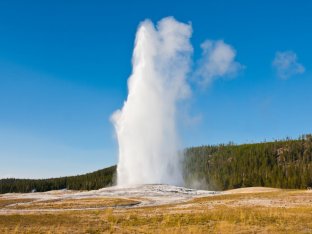
old_faithfulAnd dammit, he was right.  “America’s Best Idea,” as the concept of the National Parks has come to be known, isn’t just a clever advertising slogan.  It’s a testament to the enduring idea of setting aside something natural and beautiful and perfect so that others may someday enjoy those things, too.  I want my niece and nephews to be able to visit the parks one day.  I want them to marvel as Old Faithful shoots steam and boiling hot water a hundred feet in the air.  I want them to giggle about the sulfurous stink of the hot springs.  I want to see them stand there, mouths hanging open, as a herd of bison amble along the road, completely ignoring the cars.  I want them to see wolves and elk and big horn sheep and everything else Yellowstone has to offer, and then I want them to stand on the rim of the Grand Canyon, and hike through the river at Zion, and see the majestic peaks of the Tetons, and maybe – if any still exist – see the Glaciers at Glacier National Park.  And none of that will be possible if the federal government has sold off the Grand Canyon so that a state could sell uranium mining rights, or if the forests of Rocky Mountain National Park in Estes Park, Colorado have been logged to the point that only stumps remain.

Of course, there is another distinct possibility: that the supervolcano under Yellowstone will wake up and erupt and kill us all.  It wouldn’t be the worst thing that could happen in Trump’s America.

The Old Guitar

Let me tell you a story about a guitar.  It’s about more than a guitar, really, because most stories are about more than they seem on the surface.  I’ll probably go ahead and make the subtext really overtly-explicit text at the end, but let’s just jump into the story.

Back in late August 2010, my wife and I went to New York to visit her family.  It’s something we periodically do, taking time to see her grandfather and her aunts and uncles and cousins.  Her Uncle Joe had heard that I played guitar, and was excited to have someone to strum guitars with when we came up to visit.  I learned a couple of old ’60s and ’70s-era classic rock songs that I knew he liked so we’d have something to play.

After an hour or so of entertaining ourselves (and maybe the other people around us, though in my experience guitar playing at a gathering is usually mostly enjoyed by the folks holding the instruments), he tells me, “I got something down in the basement I want to show you.  I think you’ll really appreciate this.  Hang on a sec.”  He disappears into the house and returns a few minutes later with an old guitar case, battered and scratched but still serviceable.  “Open it up,” he said, a grin splitting his face.  I popped the latches on the case to reveal a Lake Placid Blue 1966 Fender Mustang.  Now, ’66 isn’t the most famous year for that instrument – the ’65s are probably the cream of the crop, the last year before Fender was bought out by CBS – but a ’66 is a pretty sweet instrument.  Sadly, it’s sat in the basement for decades, and the neck is so warped it’s unplayable.

It’s still beautiful, though.  All original.  With a little TLC, maybe a new neck at the worst, it’d be playable again.

And he gave it to me.  It was a remarkably kind gesture, and you could see the genuine joy and pleasure on his face.  He enjoyed giving that guitar to me almost as much as I enjoyed receiving it, I think.

I was right, though: the guitar wasn’t playable in that condition.  It needed a new neck, it needed some work on the electronics (it still needs a bit of work on the electronics and the switches, if I’m honest, but I haven’t found a good guitar tech to take care of it yet).  I got a new neck installed, and the guitar plays beautifully.  It was broken, but fixable.

And now we come to the subtext.  Well, maybe not subtext.  It’s more an analogy.  I’m about to get political (again), but it’s about something I care very deeply about: education.

I’m a big believer in public education.  I believe everyone has the right to a free and appropriate education.  That all children deserve equal access to the curriculum, regardless of disability or language barrier.  And so when I see people like Betsy DeVos, Trump’s pick for Secretary of Education, I get worried.  She’d gleefully dismantle our public education system and replace it with vouchers.  While it masquerades under the guise of “school choice,” what it really does is pull resources, students, and teachers from school systems that are already struggling, leaving the students and teachers who remain in the public school struggling more and more.  Folks like DeVos then point to those failing schools and say, “See?  I was right about public education!” even as they’re causing a lot of the problems.

There are other problems with the vouchers/school choice/charter schools paradigm that DeVos and her ilk champion.  It frequently creates a new system of segregation.  The charter schools, on the whole, don’t perform any better than the public schools.  And these private charter schools aren’t held to the same state standards and curriculum that public schools are.  Part of why folks DeVos like them so much is that you don’t have to teach things like evolution, or treat other religions and cultures with anything resembling fairness or open-mindedness.

Betsy DeVos thinks our public education system is broken.  And, as much as it hurts to say, she may be a little bit right about that.  The public system doesn’t serve everyone well.  It doesn’t do a great job of measuring student growth, or helping students do more than prepare to take big, dumb, standardized tests.  I’m all for accountability in school, but the standardized tests don’t really do it.

But is our system broken beyond repair?  Is it an unplayable guitar?  No.  It needs some work – maybe a new neck, maybe a little work on the electronics, a new set of strings – but you don’t throw the whole damn thing out just because part of it is broken.  You fix it!  The system isn’t perfect, but no system is.  It’s a damn-sight better than whatever nonsense Betsy DeVos wants to put in its place, I know that.

Book Giveaway!

I have a few digital download codes for The Invisible Crown courtesy of Royal James Publishing and Smashwords!  How do you get your hands on one of these downloads, you ask?  Well, it’s quite simple: like and comment on this post, and you’ll be entered in the drawing!  All I ask in return is a fair and honest review on Amazon or Goodreads.  I’ll be giving away five download codes at random to entrants this coming Friday, January 27th!

Inauguration Day

Here in the US, today is Inauguration Day: the day when we swear in the new President and prepare ourselves for the next four years.  I’ll be honest, I’m not looking forward to the new administration.  I have far too many friends who stand to suffer considerably as the powers that be systematically strip away a lot of the progress that was made over the last eight years.  Or eighty years, even.  It’s really hard to gauge how bad it’s going to get.

I’ve always been a proponent of the belief that the President, as a single individual with constitutionally-limited powers, can only do so much.  It’s not like being an absolute monarch, after all.  The President has two other branches of the federal government to hold him in check, not to mention his own branch filled with advisers and experts.  But this is a unique situation: the same political party controls both houses of Congress and the Presidency, and gets to appoint at least one Supreme Court Justice in the next four years.  All of that changes the dynamics of things.  Already, Congress is working to dismantle the Affordable Care Act, which – if stories from the internet are to be believed – folks across the country didn’t realize was the same thing as Obamacare (and there’s the danger of letting your opponent handle all the branding, guys: they can make it sound downright awful to you even if it’s benefiting you).

Now, I’m a straight white guy.  In many regards, nothing that happens in the next four years will hurt me in the least, assuming I don’t lose my job and have to find a new one (I wouldn’t be able to get insurance with the ACA gone, ’cause the “no pre-existing conditions” bit of the ACA – the part virtually everyone who doesn’t work for a health insurance company loves about the law – would be gone, and diabetes and mental health are huge red flags for insurance companies).  But I have lots of friends who will be affected by the sort of changes the part in power is talking about doing.  Friends who are immigrants.  Friends who are Muslim.  Friends who are gay and lesbian.  Friends with health issues and dire financial straits and all sorts of other problems.  Problems that can only be amplified by the lack of compassion the people in power display.

So, I’m spending this particular Inauguration Day in contemplation.  Thinking about what I can do to be an ally to those in need.  Thinking about how I can speak up and speak out to protect those who don’t have the same privilege and safety that I do.  Thinking about how to oppose tyranny and stand for what’s right.  Thinking about how to use the things I create – my novels, my music, my comics – to speak out against oppression and those who would do harm to those who are less-fortunate or otherwise unable to defend themselves.  I think, and I worry, and I hope and pray I can be a force for positive change.

History has its eyes on us, America.  Let’s make sure the next four years aren’t the first section of the chapter of the history textbook about America’s collapse.

Housekeeping

Conventional wisdom would indicate that the absolute worst time for an author to drop off the face of the earth would be in the month following his book’s release.  But hey, everything else about how I do things defies wisdom (conventional or otherwise), so why would I buck the trend here?

Anyway, a couple of things before I bury myself under my Author Rock™* again and get back to creating stuff.

1. The Invisible Crown is available for the Kindle, Smashwords, and as a dead-tree-actual-physical-book!  So many ways for you to show you love me.

2. Speaking of showing me love, reviews on Amazon and Goodreads are welcomed and encouraged!  Reviews help sell books, assuming they aren’t just trashing the book or my new haircut.

3. Fellow Royal James author Steen Jones has a novel coming out next month, and the pre-order for it is up today!  I’m personally super-excited about this book.  Modern-day fantasy with gateways to different worlds?  That is my jam, folks.  She’s also running a giveaway thing on her blog if you pre-order the book and snap a pic of your receipt, so you should do that.

Anyway, the underside of that Author Rock™ isn’t going to describe itself via haiku, so I’m off to go do something very much like that.

* – All authors live under rocks.  It’s where we’re most comfortable.  The official Author Rock™ is only available to any author who wants one and is willing to lug the thing around.  It is quite large and heavy, as befits a rock.

Good Vs. Awesome

The Wife and I attended a party at a friend’s place over New Year’s, where I ended up having a discussion with another friend (one of my beta readers, actually) with whom I am collaborating on a musical project this year.  She was lamenting her poor skills on the ukulele, the key instrument in the project, saying she wished she was actually good at it.

“If punk music has taught me anything,” I said, “it’s that you don’t have to be good to be awesome.”

And it got me thinking about all the folks out there who are awesome if not actually, technically good.  Take Neil Young for example.  The man’s singing voice is best described as a strangled yelp.  It sounds like someone is throttling a sick goose.  In technical terms, the man’s voice is just godawful.  He once played a guitar solo that was just the same note played 37 times.

And yet…damn, when his stuff works, it really works.  Music – and most other creative expression – isn’t just about technical prowess.  It’s also about the evocative, emotional expression.  In that regard, Neil Young is an awesome singer.  You only have to listen to “The Needle and the Damage Done” to hear the frustration and despair he feels.  His guitar playing, while often grungy and sloppy, is very emotionally-fulfilling.

Bob Dylan’s another great example.  No one can credit him with being a tehinically good singer, but take a listen to “Blind Willie McTell” and tell me that’s not a haunting song.

Like at artists like Chegal, or Picasso, or Andy Warhol.  They’re not able to perfectly recreate the details of the world around them, but they’re evocative and powerful in ways that are sometimes hard to describe.  Awesome without being good.

Anybody can play or write or draw something perfectly.  With enough practice, you can master the art of crafting a sentence or a painting or a guitar chord.  But it’s how you play things, the sounds and colors and words you don’t use.  The way you use the ones you do put to effect.  That’s what really matters, honestly.

It’s not about being good.  It’s about using what you’ve got to be awesome.

I Need Reviews!

So, as you may or may not be aware (and I’m not sure what the scenario is for that second option; maybe you were in a coma until this morning?  Or living under a literal rock without wifi?), my book is now available.  And, though I don’t know any actual numbers, a non-zero number of copies of the thing have been purchased!  This is wonderful!  It means my publisher is likely to continue giving me contracts for future books.

Of course, it’s a brand-spanking-new book, and as such it currently has zero reviews on Amazon and just one rating over at Goodreads.  This is a thing I’d like to see change!  Book reviews for small and indie authors are a necessary, vital part of the process.  No one (aside from my parents and grandparents, who love me but don’t write too many reviews) really knows about me or my book, and word of mouth is the best way to spread…well, the word.

That’s where all of you come in!  If you’ve read the book, give it a quick review!  It doesn’t have to be a massive, multi-paragraph ode to my authorial genius.  It can be as simple as, “I really enjoyed this book and would definitely recommend it.”  It also doesn’t have to be a five-star rave.  If you only kinda liked the book, that’s okay!  Even a three-star, “Eh, it was a’ight,” review is still better than no reviews.  Honest reviews are always appreciated.  Feedback and criticism are okay.  I welcome it, in fact.  Pointing out shortcomings in my writing can help me become a better writer, if it’s done properly (if it’s done improperly, or you’re just crapping on me to be a jerk, I will probably completely disregard what you said and make disparaging comments about you, the unnamed, unknown reviewer, to my wife, who tolerates my fragile ego shenanigans with grace and the occasional eye roll).

But please, share the book, tell people about it, and write reviews!  Reviews help out tremendously, encouraging readers to take a risk with an unknown author.  They also help improve the algorithms used to show folks other books they might like when they’re perusing Amazon or Goodreads, and increased eyeballs will only bring more readers in.

Hopefully, we’ll have the physical version available soon, as well as the iBooks and Nook versions.  Keep reading, and thanks!

Nostalgia Trip

I spent Christmas visiting family and friends back in Oklahoma.  It was nice to get to see everyone and cruise past some of my old haunts, but there was a moment that left me feeling a bit…off.

See, we were going to a friend of mine’s house on Christmas Eve.  She lives just off a road I’ve been down dozens, hundreds, thousands of times in my life, in a town I grew up in and spent years wandering.  I should have been able to find the place in my sleep.  And yet, I drove right past the turn, kept driving, and only figured out I’d gone too far when I came to the next major intersection several blocks up.  It threw me, not making the turn automatically, not knowing that was where the turn should be.

Now, I could easily blame it on the fact that it was night time, or that I just wasn’t paying very close attention.  But the truth was, I forgot where I was going in my own hometown.

My wife pointed out that I hadn’t lived there since I was in high school, not full-time, anyway.  Sure, I’d come back for breaks and during the summer in college, and I lived nearby during graduate school, but I haven’t frequented those streets with any regularity since I moved to Virginia twelve years ago.  It’s natural to lose some of that mental map I’d built up over the years.  But it was still a point of sadness for me, this minor misstep, because it means either (a) I’m getting dumb or (b) I’m losing a bit of the past because it’s not getting used with any real frequency.

Maybe visiting home for the holidays just left me feeling a bit nostalgic for a time that was most certainly not nearly as wonderful and pleasant as I’m remembering.  But it caught me off guard and left me feeling a little sad.

Release Day!

It’s finally here!  The Invisible Crown is now available for you to purchase and read!  I’m very excited for all of you to finally get to see the book.  Thanks to the folks at Royal James Publishing for helping get this out in the world.  If you like the book, don’t forget to leave a review on Amazon or Goodreads (or, hey, both).  Word of mouth is my most powerful marketing tool.

This also seems like an appropriate situation for this: