So, here’s a cool thing: Bob Dylan was announced last week as the winner of the Nobel Prize for Literature. The prize committee cited Dylan “having created new poetic expressions within the great American song tradition.”
And hey, that’s definitely something I can get behind. Even when he’s less than great, Dylan can still turn a phrase better than most. I thought it might be fun to run down a list of some of my favorite Dylan lyrics, in honor of his…um, honor.
Let me ask you one question/Is your money that good?/Can it buy you forgiveness?/Do you think that it should? (Masters of War)
I mean, all of “Masters of War” is classic. It’s one of those evergreen protest songs that they could play over footage of any war and it would feel pretty appropriate. There’s a sneer and a condemnation in the words, a drone in the repetitive chord progression that’s relentless and unchanging. You get the feeling Dylan fucking hates war, has always and will always hate it, and you’ll never be able to convince him it’s justified.
Voices echo/This is what salvation must be like after a while. (Visions of Johanna)
I don’t always necessarily have a lot of deep insight into a particular lyrics. A lot of his stuff just strikes me in a funny way. His turn of phrase is always magnificent. There’s an almost dismissive quality to a lot of what he sings, as though he can’t be bothered to decide if what he’s singing is profound or tremendously absurd. Maybe it’s both. I think it’s probably both.
I’m listening to Billy Joe Shaver/And I’m reading James Joyce/Some people tell me/I got the Blood of the Lamb in my voice. (I Feel a Change Comin’ On)
Yeah, it’s latter-day Dylan, and it’s sort of a throw-away set-up to get to the payoff about “the Blood of the Lamb in [his] voice.” But damn if that isn’t the perfect way to describe Dylan’s singing, with that broken-down throat that sounds like he was in a sand-gargling contest with Tom Waits after they both drank a fifth of scotch and smoked three packs of unfiltered cigarettes each.
Last night I danced with a stranger/But she just reminded me you were the one. (Standing in the Doorway)
Once, many years ago, I spent an entire blogpost dissecting this song (fair warning: I was 23 at the time, so I was pretty damn insufferable about…well, everything, but especially music). There’s just something so sad and beautiful about this pair of lines, it just kills me every time.
Then she says, “I know you’re an artist, draw a picture of me.”/I said, “I would if I could but I don’t do sketches from memory.” (Highlands)
This is the song where I got the name for my webcomic site (it’s also what I called the old blogspot blog back in the day). It’s a pretty evocative title, and the lines in the song itself are frankly pretty damn funny, when you consider the fact the subject is standing right in front of him when he says he can’t do a sketch from memory. Another situation where I can’t really tell if it’s brilliant or absurd, so it’s probably both.
I said, “You know they refused Jesus, too”/He said, “You’re not Him” (Bob Dylan’s 115th Dream)
No one spins a weird yarn like Dylan. The surreal imagery, the bizarre characters, the out-of-left-field interactions…it all swirls and twirls like a kaleidoscope stuffed with LSD. And this particular lyric epitomizes the thing folks seem to forget about Dylan too often: he’s funny as hell.
But the joke was on me/There was nobody even there to bluff/I’m going back to New York City/I do believe I’ve had enough. (Just Like Tom Thumb’s Blues)
Easily one of my favorite Dylan songs to play. It’s a twisted morality play about a place where no one has any kindness in their hearts, and the idea of returning to New York City as a place where things are better or kinder or less indifferent is sad and amazing and bizarre all at once.
You got a lotta nerve/To say you are my friend/When I was down you just stood there grinning. (Positively 4th Street)
The ultimate kiss-off song. Dylan is full of vitriol and bile, snarling the lyrics to an old flame. You almost feel bad for the subject of the song.
And I know no one can sing the blues /Like Blind Willie McTell. (Blind Willie McTell)
A simple song with just voice, piano, and an acoustic guitar (played by Mark Knopfler of the Dire Straits), borrowing the tune of the old blues standard “St. James Infirmary” and acting as a history of race relations and slavery in America. A blues song about the blues. A lament that one does not fully possess the capability to express what is in the heart. No one can sing the blues like Blind Willie McTell, but Dylan comes damn close in this song.
They say prayer has the power to heal/So pray for me, mother /In the human heart an evil spirit can dwell /I am trying to love my neighbor and do good unto others /But oh, mother, things ain’t going well. (Ain’t Talkin’)
Dylan famously went through a born-again Christian phase in the late ’70s/early ’80s, and while those albums weren’t the greatest, he’s managed to put the biblical imagery to better and more effective use since then. This is a perfect example: referencing the power of prayer, the Golden Rule, and the struggle to be who you’re supposed to be.
So, that’s ten of my favorite bits of Dylan lyrics. What’re your favorites?
 Slow Train Coming (1979): The first of the trio, and widely considered the strongest. The album opens well with “Gotta Serve Somebody,” a song that’s solid-enough to be a legitimate part of the Dylan canon even now. That’s followed by “Precious Angel,” a song with pretty great instrumentation and some of the blandest lyrics imaginable. Dylan sounds bored while singing, like he can’t be bothered to try. There’s no conviction to it. “I Believe in You” Has the same problem (in addition to some pretty strangled, strained vocal efforts by Bob) and an uninspired instrumental piece. Things are not looking good for the album. Things pick back up, though, with “Slow Train,” where Dylan’s lyrics are more circumspect and he sings them with more conviction. Knopfler’s guitar work doesn’t hurt, either. It kinda sags in the back half, though “Man Gave Names to All the Animals” is fun and relaxed. The album ends with “When He Returns,” a slow piano-led paean to Jesus that just drags out for a every second of almost four-and-a-half-minute run time. On the whole, not a classic album, but pretty solid. Three of the nine songs are pretty great, which isn’t the best ratio but it’s better than nothing.
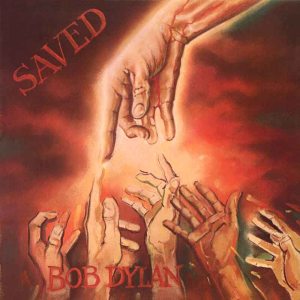 Saved (1980): Saved opens with a mostly-acapella rendition of the old spiritual “Satisfied Mind,” which is pretty awesome. It’s followed by the title track, which plays out like a tent revival gospel sing-along. “Covenant Woman” isn’t bad; a middling Dylan song that veers a little deeper into schmaltz than you’d like, but is still likable enough. “What Can I Do For You?” feels like Dylan doing a Dylan impression, right down to the harmonica solos. “Solid Rock” picks up the pace a bit, which is appreciated, and almost feels like a Tom Petty song. “Pressing On” is genuinely great, a solid mixture of Dylan’s lyrical concerns and instrumentation that feels inspired, passionate, and heartfelt in a way the previous couple of songs just don’t. It’s followed by “In the Garden,” which feels like something you might’ve heard on the 700 Club back in the day (that’s not a good thing). “Saving Grace” has a similar tone and church organ intro. The album ends with “Are You Ready,” which aims for slow-burn Chicago blues but just feels forced. Overall, Saved is definitely weaker than Slow Train Coming. The good songs aren’t as good as the best of Slow Train Coming, and it just feels pedestrian in too many places.
 Shot of Love (1981): The third and final album of the Born Again Trilogy starts out strong with the title track, though it does get a bit preachy here and there. “Heart of Mine” is a good follow-up, maintaining a solid rhythm and pretty good lyric read from Dylan. “Property of Jesus” falls flat, feeling too much like a cookie-cutter praise song from a middling praise and worship band. “Lenny Bruce” is just straight-up boring, and “Watered-Down Love,” despite an awesome title and concept, feels watered down and flat itself. “The Groom’s Still Waiting at the Altar” comes out of nowhere, though, feeling like a song from a different time and a different Dylan. It’s a shock to the system, a swift kick in the ass that electrifies. It’s followed by the reggae-inflected “Dead Man, Dead Man,” which finds Dylan hollering and shouting like the best tent revivalist. The album stumbles a bit with “In the Summertime” and “Trouble,” but ends strong with “Every Grain of Sand,” a song that (while kind of boring musically) draws on Christian themes in the way Dylan should’ve been doing since Slow Train Coming, honestly. It’s heartfelt and clever and inspired, and a great way to close out the trilogy.

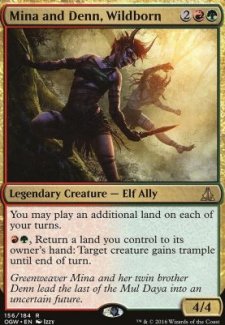 So, the deck. For the Commander, I went with
  Charlie Cottrell